PQMex® technical data
All technical data of the PQMex® at a glance – compiled from the datasheet and the operating manual. For planning, tendering and preparing the installation.
 // PQMex®
The key figures of the PQMex®
4096 px · 25 µm
25 kHz
± 1 µm
Ø 25 mm · 30:1
240 °C
6
From granulate to quality grade
The PQMex® extrudes a sample of the material under test into a blown film and inspects it directly in the running web. The measurement interval is freely adjustable, for example every two minutes: the PQMex® then takes a sample from the granule stream – automatically via Venturi nozzles if required – and extrudes it into a blown film. By controlling the bubble diameter, the film thickness stays within the tolerances of DIN SPEC 91522. Based on the required measurement area, for example per m² or per 100 cm², the system outputs a quality value: the weighted number of gels per size class.
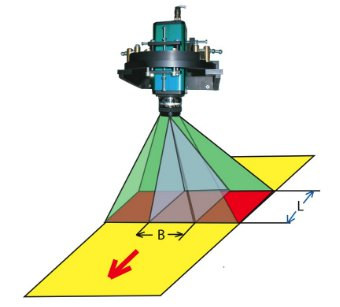
How the line-scan camera inspects
The PQMex® uses a line-scan camera in transmitted light: camera and lamp face each other across the film. The camera captures one line at a time; the complete image is built up as the film moves past.
The average brightness of each rectangle is evaluated. Above the upper tolerance value the system detects a bright defect; below the lower one, a dark defect.
Specifications in detail
All data refer to the standard configuration. Values are nominal unless a tolerance is stated. Subject to technical change without notice; these data are not a guarantee of properties.
Installation and commissioning
Site
Flat, level and load-bearing surface. No structural foundation is required.
Environment
Clean and dry. The PQMex® is intended for indoor use only.
Clearances
1 m on each side of the machine for operation, maintenance and escape routes.
Mobility
Fully relocatable unit – can be positioned flexibly within your facility.
Connectivity
Electrical, compressed air and network supply are designed as plug-and-play connections.
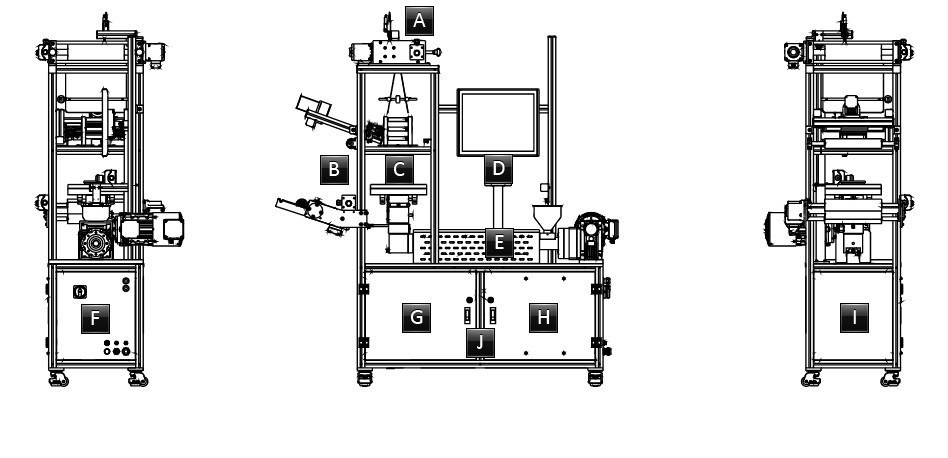
Layout and interfaces
- A
- Top of the tower – Haul-off and optional thickness-measurement probe
- B
- Front film path – Line-scan camera and lamp in transmitted light, winder
- C
- Centre of the tower – Die with bubble, bubble guide and bubble-diameter sensors
- D
- Monitor stand – Touchscreen and emergency-stop switch
- E
- Extruder – Feed hopper, screw, heated barrel with heating zones barrel 1–3 and feedblock, drive at the rear
- F
- Right side wall – Main switch, mains, Ethernet and compressed-air connections
- G
- Left door – Lockable, with R.A.M. logo
- H
- Right door – Industrial PC, lockable
- I
- Left side wall – Type plate
- J
- Base cabinet – Pneumatic components and other utilities
Pre-start checks
Before first commissioning, and again after every relocation, check that:
- the machine stands level and stable on a flat, load-bearing floor and cannot move under load
- the clearances of 1 m on each side required for operation, maintenance and escape routes are maintained
- the supply voltage, frequency and upstream fuse protection match the electrical supply data, the machine is connected to the protective earth, and the required residual-current protection is present
- the compressed air is oil-free and dry and is within 7–10 bar
- all guards, covers and doors are fitted and close correctly, and the type plate and all safety labels are present and legible
- the emergency-stop device functions: press it, confirm that the screw drive, the haul-off and the winder stop, then unlatch it and confirm that the drives do not restart by themselves
- the extrusion die has been calibrated in accordance with the calibration manual, if it was removed for transport or maintenance
- the operating and maintenance personnel have been instructed and the CAMEN access levels have been assigned
Record the commissioning and the results of these checks. A machine showing transport damage must not be commissioned. In all cases, the operating manual supplied with the machine takes precedence.
Directives and standards
2006/42/EG
Machinery Directive
2014/30/EU
Electromagnetic compatibility
2011/65/EU
Restriction of hazardous substances (RoHS)
2012/19/EU
Waste electrical and electronic equipment (WEEE)
The PQMex® bears the CE marking. The EU declaration of conformity, stating the legislation and harmonised standards applied, is supplied with every machine as a separate document. Unauthorised modifications void CE conformity.
EMC notice: the machine is Class A equipment in accordance with EN 55011 and EN IEC 61000-6-4. It is intended for industrial electromagnetic environments and is not intended for use in residential environments.
Applicable documents
The English version is the original instructions within the meaning of Directive 2006/42/EC, Annex I, item 1.7.4.1; the German and Polish versions are translations of the original instructions.
This page summarises technical data and does not replace the documentation supplied with the machine. Operation, calibration and maintenance are governed exclusively by the manuals accompanying the machine. The complete documentation is available from our service department.
Standard equipment and options
Standard
- Bubble diameter measurement
- Material level – required for auto start/stop
- Speed monitoring – on haul-off and winder
- Reverse buttons – on haul-off and winder
- Over-temperature protection
- Pneumatic contact pressure – automatic opening and closing of the haul-off rollers
- Acrylic glass enclosure
- Antistatic brush – removes static charges from the extruded film
- CAMEN version 12 – measurement and evaluation software with recipe management, defect classification and roll reporting
- Internal SQL database – storage of measurement data locally on the industrial PC
Options
- Thickness measurement
- Autofeeding (Venturi) – automatic pellet feeding into the hopper; hose length up to 10 m or over 10 m, from one or two sources
- Silo control – for quality-based sorting
- Automatic recipe switching – via PLC inputs
- Variable bubble cooling
- Winding core with spring tensioner – winding of the film web for later inspection
- Production-environment version – contamination protection for the base through additional enclosure and forced ventilation
- Signal light
- RAID – additional storage solution
- Additional inputs and outputs – as required
- vSTAT version 1 – freely configurable reports and statistics
Maintenance intervals and operating supplies
Record-keeping duty: every routine maintenance operation, every cleaning operation carried out because of a material change or a fault, and every oil change must be recorded with operating hours, date, work carried out, parts and operating supplies used, and the name of the person who carried out the work (German Ordinance on Industrial Safety and Health, BetrSichV § 3; German Social Accident Insurance regulation DGUV Vorschrift 1). The records form part of the machine documentation and are presented at the annual service.
Only the operating supplies specified here, or supplies expressly approved by R.A.M., may be used. Unsuitable supplies can damage the machine, impair measurement accuracy and void the warranty. Observe the safety datasheet of every substance used.
The annual service and all repairs are carried out by R.A.M. Kunststofftechnik GmbH. The detailed procedures for cleaning, maintenance and calibration are given exclusively in the accompanying manuals MAN-PQMEX-DE/EN-002 and -003.
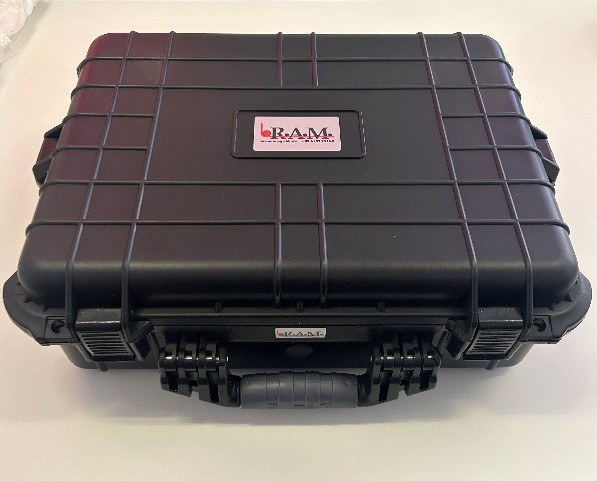
Calibrating the extrusion die
Mechanical calibration uses a dedicated calibration set: die calibration unit, torque wrench and tools, housed in a dust-tight IP67 case that protects the calibration unit against impact, dust and moisture.
The procedure is described in the calibration manual MAN-PQMEX-EN-002.
Questions about the technical data?
We will review connection values, space requirements and integration into your line with you – and provide the complete documentation.