Gels and fish-eyes
Appearance: Small lens-shaped thickenings in the film, often with a light halo or tail.
Typical cause: Unmelted or cross-linked polymer particles and degraded material; in recyclate often foreign polymers and contamination.
Detection: In transmitted light as a deviation from the surroundings; size and shape allow classification as gel or fish-eye.
Suitable systems: PQMex® · ITG 500 – Gel Analyser · ITG 500 – Bench Analyser · FIS 1000
Specks and black specks
Appearance: Dark, mostly sharply defined dots in or on the film.
Typical cause: Thermally degraded residues from barrel or die (burnt material), carbon particles and foreign matter – especially with fluctuating recyclate quality.
Detection: With high contrast in transmitted light; in reflected light for opaque films.
Suitable systems: PQMex® · FIS 1000 · ITG 850 – LC · ITG 500 – Bench Analyser
Holes and pinholes
Appearance: Openings through the film, often only fractions of a millimetre and invisible on the roll.
Typical cause: Torn gels or foreign particles and thin spots; in barrier films this destroys the protective effect.
Detection: In transmitted light as a bright dot against a darker background.
Suitable systems: FIS 1000 · ITG 850 – LC · PQMex®
Contamination and foreign matter
Appearance: Dust, fibres, insects or particles in or on the web.
Typical cause: Introduced from the environment or the material feed; electrostatically charged film attracts dust.
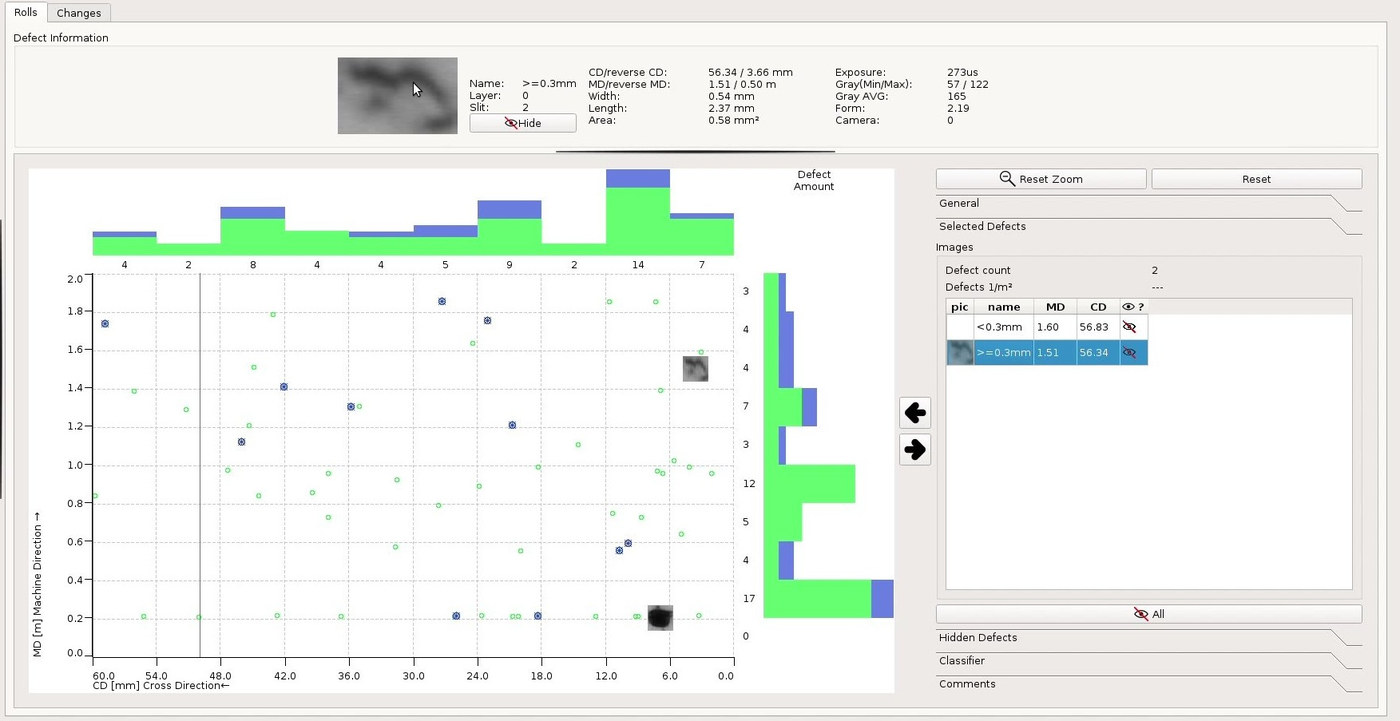
Detection: In transmitted or reflected light depending on the material; the defect map shows whether defects cluster in one place.
Suitable systems: FIS 1000 · ITG 850 – LC · PQMex®
Streaks and die lines
Appearance: Elongated, often faint structures in the machine direction.
Typical cause: Damaged or contaminated die lips, deposits in the die or an inhomogeneous melt.
Detection: Defects at the same cross-web position appear as a line in the defect map – a pointer to the cause in the die.
Suitable systems: FIS 1000 · CAMEN
Haze
Appearance: Milky, extensive clouding instead of clear film.
Typical cause: Moisture in the material, poorly compatible plastic blends or insufficient homogenisation – typical of recyclates.
Detection: In transmitted light via the light transmission of the test film.
Suitable systems: PQMex® · Sample analyses